
aec-o2: carbon credits for the people who design and build
a public-policy proposal to give carbon credits to design and construction teams when their projects emit less than the average. a building's carbon is decided in the design and on site.
a public-policy proposal that entrópica prepared in june 2020 for chris ling, an architect in melbourne.
the gap
carbon markets apply mostly to the industry that extracts and processes resources: cement, steel, energy. this proposal calls these industries “pre-consumer cycles”.
the architecture, engineering and construction (AEC) industry sits outside these markets. and yet it is the AEC industry that decides the fate of much of those resources. it does not make the concrete, but it does decide how much concrete gets used, where and for what.
the AEC industry produces the built environment, where people spend close to 90% of their lives. so it controls two kinds of carbon:
- embodied carbon: what the materials and the works emit.
- operational carbon: what the building emits in use.
AEC-O2 proposes giving carbon credits to design and construction teams when their projects emit less carbon than the average.
the mechanism
the proposal uses one central tool: the carbon wallet.
- the local authority sets an average for each project type (housing, office, school and others).
- the project team proves, with third-party verification, that its project is below the average.
- the team receives a carbon wallet. every member is a shareholder of the wallet, and they negotiate the percentages among themselves.
- each year the project stays below the average and occupied, the wallet receives credits.
- the team sells the credits to companies that emit carbon, inside a market with an emissions cap.
the average drops over time, so the market demands continuous improvement.
participation is voluntary. the proposal frames it as an implementation phase before a stricter regulation.
phase 1 · construction
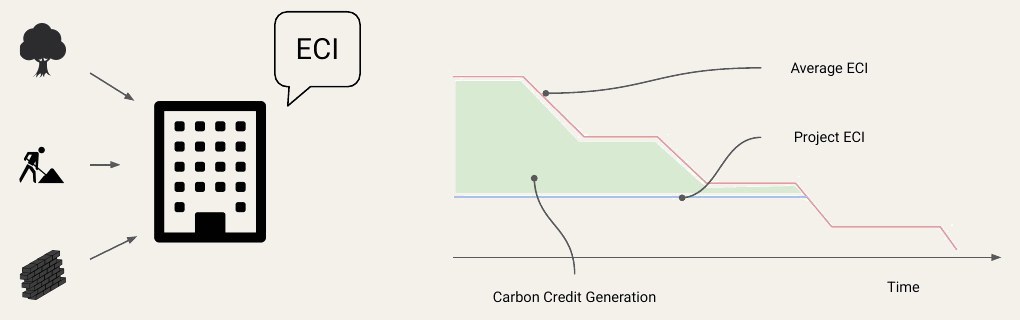
this phase rewards construction teams. the metric is embodied carbon intensity (ECI), in kg CO₂e/m².
| article | rule |
|---|---|
| 1 | the local authority sets the average ECI of each project type. the average is adjusted every four years. |
| 2 | the construction team may file third-party-verified documentation to prove an ECI below the average. |
| 3 | if it proves this, the team receives a carbon wallet. |
| 4 | each year the project’s ECI stays below the current average, the wallet receives credits. the project must be occupied. |
| 5 | credits = (average ECI − project ECI) × project area. |
| 6 | the team may sell the credits in the market with an emissions cap. |
expected effects:
- teams seek materials and processes with an ever-lower ECI.
- the count includes the whole construction process, so the project’s location enters the math. suburban projects lose appeal. urban infill, renovation and retrofit gain it.
- construction teams ask design teams for local materials and low-carbon techniques.
- construction can work as a carbon sink. the real appeal depends on the emissions cap and the price of the credit.
phase 2 · operation
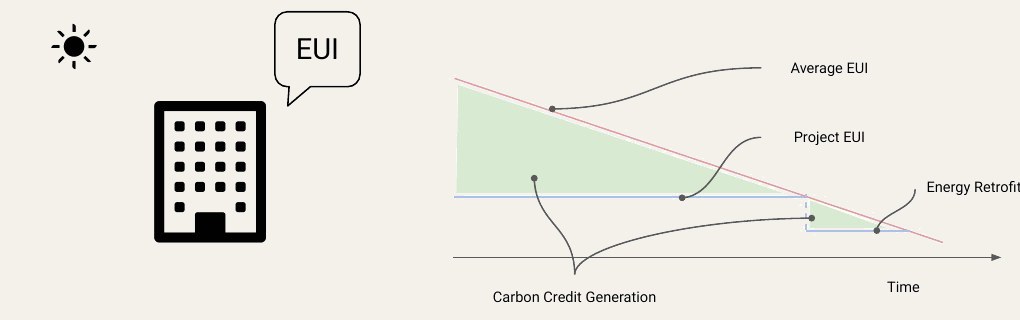
this phase rewards design teams. the metric is energy use intensity (EUI), in kWh/m²·year.
| article | rule |
|---|---|
| 1 | the local authority sets the average EUI of each project type. the average is adjusted every year. |
| 2 | the design team may file third-party-verified documentation to prove an EUI below the average. |
| 3 | if it proves this, the team receives a carbon wallet. |
| 4 | each year the project’s EUI stays below the current average, the wallet receives credits. the project must be occupied. |
| 5 | credits = (average EUI − project EUI) × project area × grid emission factor. |
| 6 | the team may sell the credits in the market with an emissions cap. |
expected effects:
- efficient design produces measurable income. design teams have a reason to educate the client and invest in simulation and in energy-performance staff.
- energy-performance specialists become an asset for firms with many projects.
- an energy retrofit can bring an existing building back below the average, and the building starts generating credits again.
conclusion
a building’s carbon is decided in the design and on site. measuring each project’s ECI and EUI against an average is the first step toward giving that performance a market value.