
manzil basit.
what cools a room in the desert? before designing this house in abu dhabi, we tested six strategies on a single room. with no air-conditioning, it went from comfortable 20% of the year to 67%.
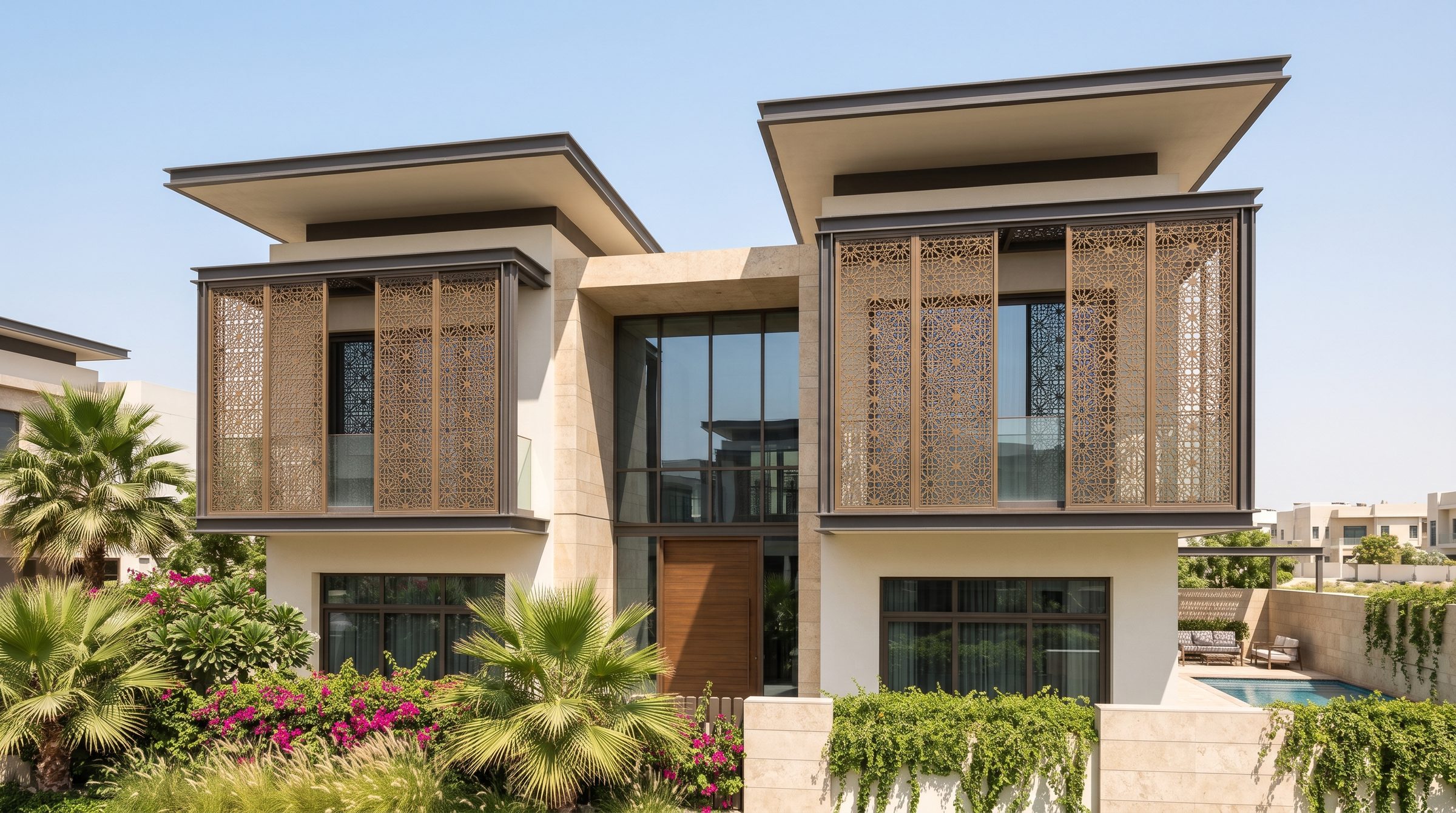
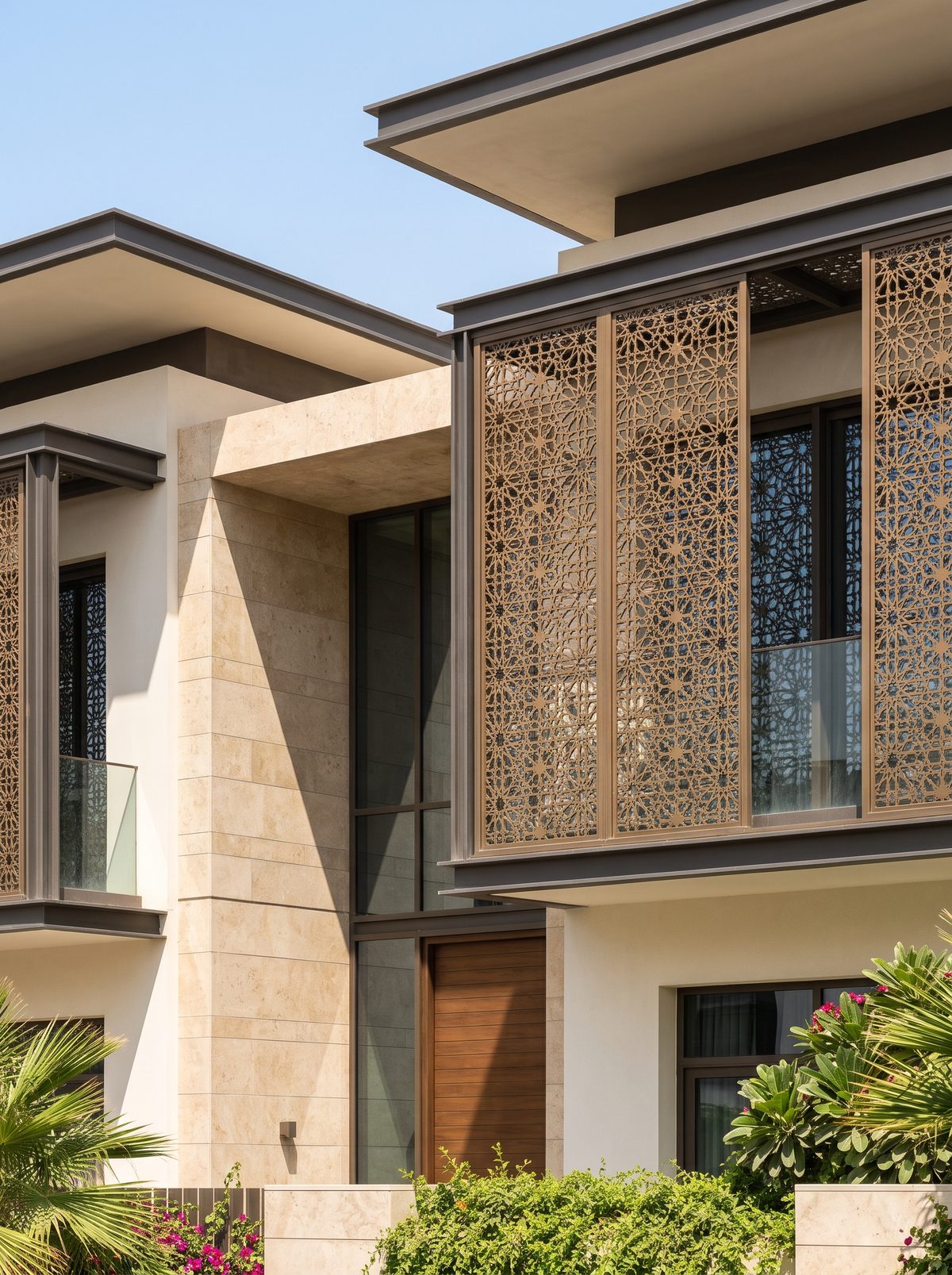
// ai visualization, based on the client's conceptual design
more comfortable hours a year, same room, no air-conditioning.
simulated with the abu dhabi climate. the images of the house are ai visualizations based on the client's conceptual design.
what was asked, and how it was solved.
manzil basit, "simple house" in arabic, is a private house in abu dhabi. outdoors, half the year brings heat stress, even in the shade.
before any design, we tested one 6 × 9 × 3 m room with six strategies, one after the other.
air and water helped most: ventilation, moving air and cooling with water. blocking the sun added half as much.
those ideas don't show in a picture. that is why the study came before the design.
the study in five numbers.
| value | what it means |
|---|---|
| 3.4× | more comfortable hours a year, same room, no air-conditioning |
| 19.72 → 66.67% | share of the year inside the adaptive comfort band, base room to final room |
| 64% | of the gain from air and water (ventilation, felt air movement, evaporative cooling) |
| 32% | of the gain from blocking the sun (window shading, double roof) |
| 14 °C | median cooling available from evaporating water in the hours above 35 °C |
the air is hot, but it is dry
every hour of the year in abu dhabi. it is hot outside, but the air is dry: in the hours above 35 °C, evaporating water can cool it by 14 °C.

six moves, ranked
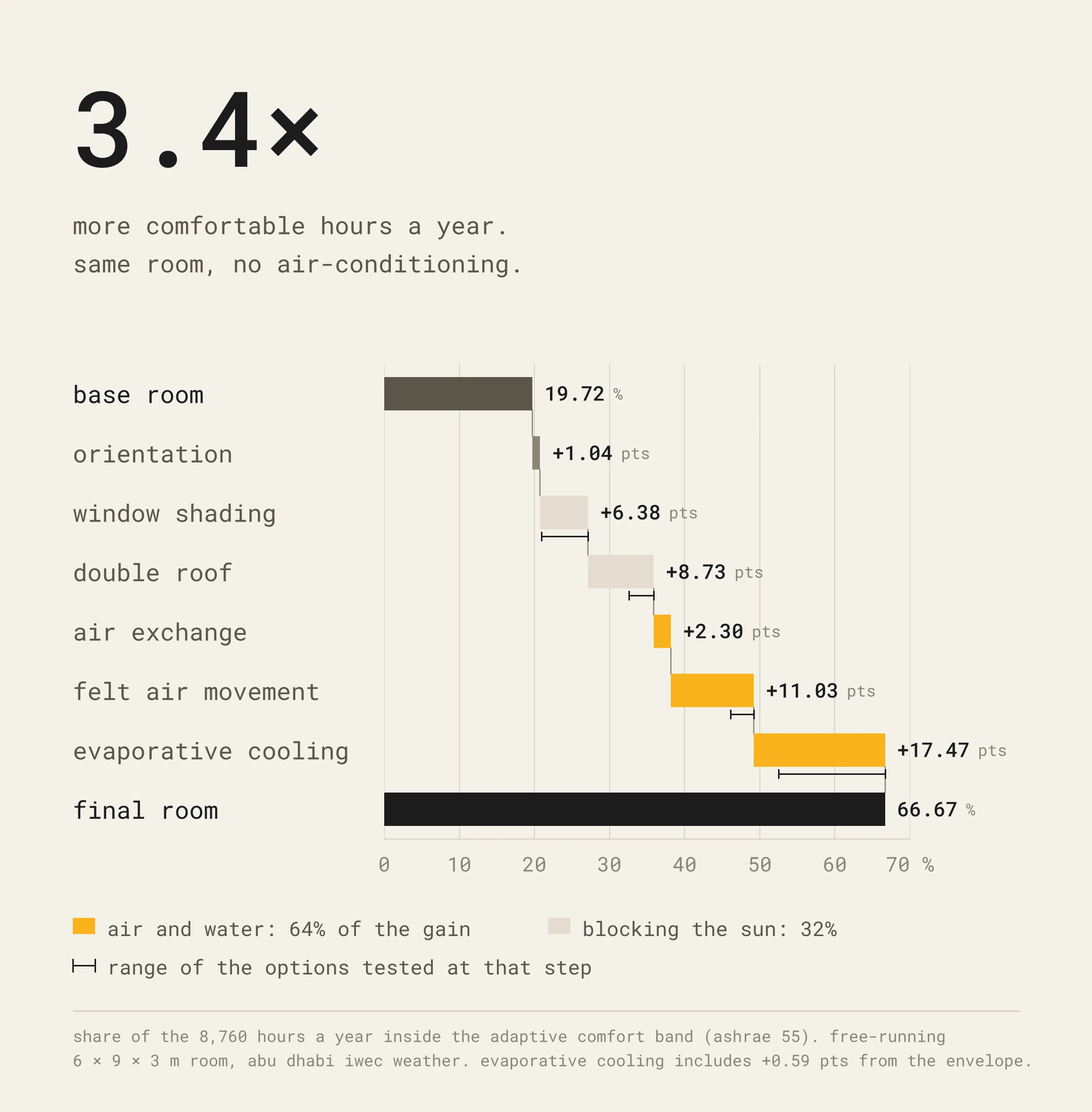
each bar adds one strategy to the room. cooling with water adds the most (+17.47 points) and orientation almost nothing (+1.04). the room ends up comfortable 66.67% of the year.
- +17.47 pts evaporative cooling
- +11.03 pts felt air movement
- +8.73 pts double roof
- +6.38 pts window shading
- +2.30 pts air exchange
- +1.04 pts orientation
every hour of the year, before and after
every hour of the year, before and after. the base room is too hot almost every afternoon; the final room is comfortable most of the year. some winter mornings now run cool.

with the room ventilated, more glass buys nothing
with the room ventilated, going from 30% to 80% glass barely changes comfort (−3.07 points). the glass can follow the view and the light. we kept 30%.
| window-to-wall ratio | comfortable hours a year |
|---|---|
| 30% | 49.20% |
| 45% | 47.83% |
| 50% | 47.48% |
| 65% | 47.08% |
| 80% | 46.13% |
how we got the numbers.
- climate: abu dhabi international airport, iwec weather file (8,760 hours).
- model: one free-running 6 × 9 × 3 m room (heavy concrete walls, single clear glass, 40% glazing to start), simulated in energyplus through honeybee for grasshopper.
- comfort: ashrae 55 adaptive model, 90% acceptability band (±2.5 °C around the target), monthly mean outdoor temperature.
- steps are cumulative: each strategy is added to the best case of the step before it.
- ventilation is shown in two parts: air exchange (the room with still air) and felt air movement (the comfort band widened by the air speed; the study used the weather-file wind speed).
- evaporative cooling: 80% efficiency against the outdoor wet-bulb temperature, applied when the room air is above 29 °C. this step also includes +0.59 pts from an upgraded envelope (ashrae 189.1).
- check: in 2026 we reran the archived 2020 models (energyplus 9.1). the rerun matches the delivered study within 0.3 pts.
study and graphics: entrópica. tools: energyplus, ladybug tools (honeybee, ladybug), python.